Why Thailand’s New Power Plan Trades Least-Cost Logic for an Expensive Gas Gamble
Why Thailand’s New Power Plan Trades Least-Cost Logic for an Expensive Gas Gamble
On the surface, Thailand’s draft Power Development Plan (PDP 2026) reads like a climate breakthrough. For the first time in the nation’s energy planning history, policymakers have explicitly linked power generation targets to Thailand’s Nationally Determined Contributions (NDCs), touting higher renewable energy uptake and presenting three long-term scenarios that ostensibly meet emissions goals. It makes for compelling green soundbites.
Yet a closer look under the hood reveals a troubling sleight of hand: the plan’s climate pathways only diverge in the distant future, while the first 12 years are rigidly locked into an expensive, fossil-heavy trajectory that abandons least-cost planning at the expense of Thai consumers.
Rather than charting a cost-effective green transition, the two-phase structure of the draft PDP 2026 front-loads massive fossil fuel commitments and unproven, high-cost technologies.
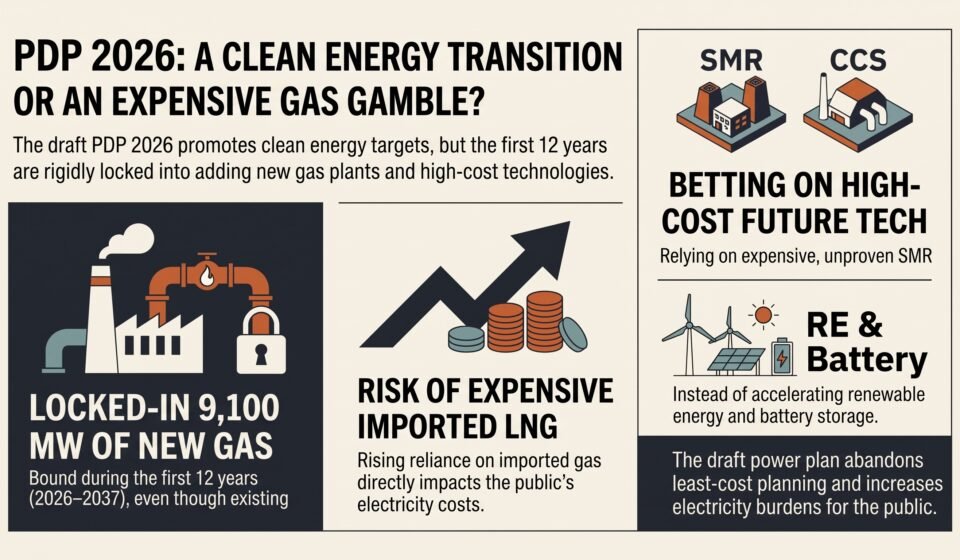
According to an analysis by the Institute for Energy Economics and Financial Analysis (IEEFA), the draft PDP locks in 9,100 MW of new gas-fired capacity during its initial phase through 2037, driving gas demand and liquefied natural gas (LNG) exposure steadily upward. By deferring meaningful divergence to post-2037 scenarios, policymakers are kicking the decarbonization can down the road while handing households and industries a multi-billion-baht bill.
1. The 12-Year Lock-In: Building New Gas While Existing Plants Sit Idle
Presenting three “NDC-compliant” scenarios for 2038–2050 is deeply misleading when the immediate 12-year horizon (2026–2037) is fixed across the board with 9,100 MW of new gas. Worse still, this near-term gas expansion defies the most basic rule of least-cost utility planning: you do not build new power plants when your existing fleet is gathering dust.
IEEFA’s analysis of company financial reports reveals that in 2025, nearly all Independent Power Producer (IPP) gas plants in Thailand operated below a 50% capacity factor. Astonishingly, seven gas plants totaling 11 GW of capacity operated less than 10% of the time. Because of rigid take-or-pay and availability contract structures, the Electricity Generating Authority of Thailand (EGAT)—and ultimately Thai ratepayers—still had to pay for these idle plants. Since 2023, EGAT has paid 159 billion baht ($5.02 billion) to those seven underutilized facilities, including 61 billion baht during months when they generated zero electricity.
Running Thailand’s existing IPP gas fleet at full capacity could generate an additional 98.9 TWh of electricity per year—more than enough to meet expected load growth through 2037 without building a single megawatt of new gas. Forcing 9,100 MW of new gas onto the grid during the first 12 years will only inflate this availability payment burden while squeezing out cheaper renewable energy.
2. Fantasy Gas Economics vs. Global Market Reality
To justify this near-term gas build-out, the draft PDP relies on outdated, artificially low cost assumptions. The plan assumes new gas plants can be built for 31,500 baht/kW ($937/kW). In reality, global capital costs for gas plants have surged three- to four-fold over the past four years due to severe gas turbine shortages, reaching $2,500 to $3,000/kW. Supply chains are so bottlenecked that equipment lead times stretch 5 to 7 years, with manufacturers demanding non-refundable upfront payments of up to 20% just to secure a manufacturing slot. Across Thailand, Vietnam, the Philippines, and Bangladesh, $56.1 billion worth of LNG power projects have been cancelled or stalled over the past five years due to these exact financing and equipment hurdles.
Fuel economics are equally punishing. As domestic gas production in the Gulf of Thailand dwindles, LNG’s share of Thailand’s gas supply has doubled this decade to 27%. In 2025, imported LNG cost double domestic gas and 29% more than pipeline imports. With Middle East conflicts keeping global LNG markets tight through 2028 and spot JKM prices hovering near 983 baht/MMBtu, LNG is a fiscal time bomb.
At $23/MMBtu, a single LNG cargo costs $84 million—enough to buy 930 MW of solar modules. A 1 GW LNG plant burns through $1.12 billion in fuel annually, generating electricity at $212/MWh (7.13 baht/kWh), compared to the global average solar levelized cost of $40/MWh. Every 10% rise in gas prices drives Thai electricity tariffs up by 3.5%, and tariffs always rise faster than they fall as EGAT scrambles to recoup past subsidy debts.
3. Speculative Bets: The SMR and Carbon Capture Mirages
Instead of scaling proven, low-cost domestic renewables right away, the draft PDP’s long-term decarbonization math leans heavily on two commercially unproven, exorbitant technologies: Small Modular Reactors (SMRs) and Carbon Capture and Storage (CCS).
In another departure from least-cost planning, the draft PDP slots in 300 MW of nuclear SMR capacity within the first 12 years, followed by a massive 8,700 MW of additional SMR capacity by 2050 across all long-term scenarios—bringing total planned SMR capacity to 9,000 MW. Yet commercial SMRs remain largely theoretical. Only two operational SMR projects exist in the world today (state-backed prototypes in Russia and China), and neither operates on a competitive commercial basis. In the United States, the flagship commercial SMR project—NuScale’s Carbon Free Power Project—was famously cancelled after projected construction costs skyrocketed from $3.6 billion to $9.3 billion, rendering its power far too expensive for utilities to buy.
The plan’s reliance on CCS to clean up its fossil fleet is equally detached from reality. The draft PDP envisions capturing 21 to 32 million tonnes of CO2 (MtCO2) by 2050—an astonishing target given that total global CCS capacity across all industries today is just 62MtCO2. Globally, there is not a single commercial-scale gas-fired power plant operating with CCS. Moreover, the PDP’s assumed capture cost of 135/MtCO2 omits transport, storage, and energy penalty costs, while low plant utilization rates would send per-unit capture costs through the roof. Betting Thailand’s climate targets and consumer tariffs on speculative SMRs and non-existent gas CCS is a high-stakes gamble with public money.
4. Missing the Clean Tech and Data Center Boom
The old excuse that gas and nuclear are the only ways to ensure reliable power no longer holds water. According to BloombergNEF (BNEF), four-hour battery storage paired with solar now beats gas peaking plants on cost globally. By 2030, BNEF projects solar-plus-storage in Thailand will fall into a highly competitive 1.5 to 2.7 baht/kWh range, decisively undercutting volatile gas IPP generation costs.
Furthermore, Thailand is actively courting billions of dollars in foreign investment from hyperscale data center operators like Alphabet, AWS, Equinix, and STT GDC. Nearly all of these tech giants have strict 85% to 100% clean power targets by 2028–2030. They cannot wait until 2040 for speculative SMRs or CCS, nor do they want carbon-intensive LNG. They want immediate, cost-competitive Direct Power Purchase Agreements (DPPAs) for renewable energy. High wheeling charges and punitive imbalance fees currently stifle Thailand’s DPPA market, threatening to drive foreign tech investment to regional neighbors.
A Call for True Least-Cost Planning
A power plan that locks in 9,100 MW of unneeded gas and 300 MW of unproven SMRs over the next 12 years—while deferring real climate action to post-2037 mirages of 8,700 MW of SMRs and massive CCS—is neither green nor economical.
Before the National Energy Policy Council (NEPC) and the Cabinet stamp their approval on PDP 2026, planners must return to genuine least-cost principles. That means including the cost of CCS as part of new gas-based generation, halting the 9,100 MW gas expansion, and prioritizing cost effective RE and battery over speculative nuclear and CCS, optimizing existing grid assets, and opening up grid access. As IEEFA rightly concludes: every baht spent on imported LNG is a cost imposed on Thai households and businesses, whereas every megawatt of domestic renewable energy is an investment in true energy security.